
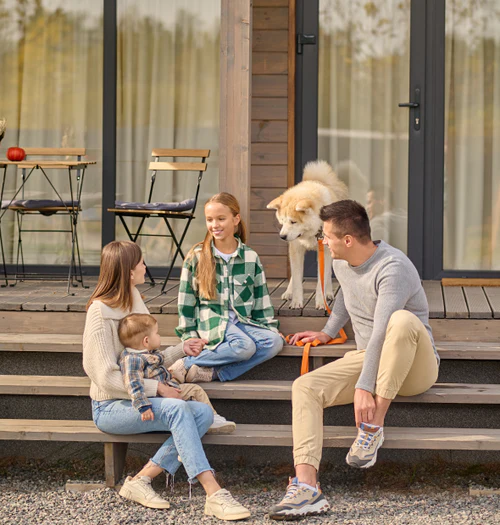
Building a terrace is one of the more significant investments a homeowner or developer makes in a property. Done well, it adds usable space, increases property value, and looks beautiful for decades. Done with the wrong material, it becomes a maintenance headache — warped boards, greying surfaces, chemical treatments to reapply, and eventually replacement.
This guide is for anyone currently choosing a decking material for a terrace, deck, or outdoor living space. We cover the main options available in Europe, what each actually delivers over a 10–20 year horizon, and how to make a decision you won’t regret.
The Main Options for Outdoor Decking in Europe
1. Untreated Softwood (Pine, Spruce)
The cheapest option. Untreated pine or spruce decking is widely available, easy to work with, and looks attractive when new. The problems emerge quickly: untreated softwood begins to grey and crack within the first season if not treated, and requires annual maintenance (sanding, oiling or staining) to maintain appearance. Without consistent maintenance, rot and fungal damage typically appear within 5–8 years in Northern and Central European climate conditions.
Suitable for: temporary structures, tight budgets where replacement is expected within 10 years, painted or heavily treated surfaces.
Not suitable for: long-term residential terraces, pool areas, low-maintenance projects.
2. Pressure Treated Softwood
A step up from untreated timber. Copper-based chemical preservatives are forced deep into the wood fibres, giving it resistance to rot and insect attack. Pressure treated decking is the most common choice for budget terrace projects across Europe and is readily available at builders’ merchants.
Lifespan: 15–20 years for above-ground applications with adequate maintenance. Performance declines without regular re-sealing or staining (typically every 2–3 years).
The environmental concern: copper-based preservatives can leach into surrounding soil and water over time, which is relevant for terraces near planted areas, vegetable gardens, or pool water. EU regulations on treated timber near water are increasingly strict.
Suitable for: budget projects, structural applications (posts, joists), situations where regular maintenance is acceptable.
Not suitable for: pool surrounds, food garden terraces, projects where long-term maintenance commitment is not feasible.
3. Tropical Hardwood (Ipe, Bangkirai, Teak, Cumaru)
Tropical hardwoods are genuinely excellent decking materials — dense, naturally durable, and beautiful. Ipe (Brazilian walnut) in particular has an outdoor lifespan of 25–40 years with minimal maintenance.
The problems are sourcing and cost. Legally certified tropical hardwood is expensive — typically €80–150 per m² or more, significantly above thermally modified pine. And the supply chain is complex: despite certification schemes (FSC, ITTO), illegal logging remains a serious issue in tropical timber markets. In 2025, the EU Deforestation Regulation (EUDR) imposed new due diligence requirements on tropical timber imports that add complexity and cost for buyers.
Suitable for: premium projects where budget is secondary, buyers with confidence in their supply chain.
Not suitable for: cost-sensitive projects, buyers who want clear environmental credentials.
4. Composite Decking (Wood-Plastic Composite / WPC)
Composite decking — made from recycled wood fibres and plastic — has improved considerably in quality over the past decade. Good quality composites offer excellent durability (20–25 year warranties are common), low maintenance, and resistance to moisture, mould, and insects.
The compromises: composite doesn’t look or feel like real wood. Despite improvements in surface texture and colour, it lacks the grain variation, warmth, and tactile quality of timber. It can feel hot underfoot in direct summer sunlight. At the end of its life, it cannot be composted or recycled in the same way as solid wood. And the premium end of the composite market is priced comparably to thermally modified wood.
Suitable for: buyers who want absolute minimum maintenance and don’t mind sacrificing the look and feel of real wood.
Not suitable for: projects where natural aesthetics are important, buyers who prefer sustainable materials.
5. Thermally Modified Wood (Thermowood)
Thermally modified wood — particularly thermally modified pine — has become increasingly popular across Northern and Central Europe for residential and commercial terraces. The process uses only heat and steam to permanently change the cellular structure of the wood, resulting in a material that:
- Absorbs up to 40% less moisture than untreated timber
- Is rated Class 1–2 biological durability (equivalent to oak for above-ground applications)
- Contains no added chemicals
- Has a naturally rich, deep caramel-brown colour
Lifespan: 25+ years above ground with appropriate installation and periodic oiling to preserve colour (or left to silver naturally — both are valid choices).
Suitable for: residential terraces, pool surrounds, commercial outdoor spaces, facade cladding, screening, low-maintenance projects, projects near water or planted areas.
Not suitable for: ground contact or structural load-bearing applications (posts, beams).
How to Compare: The Questions That Matter
How long do you need it to last?
If the answer is 10–15 years and you’re comfortable with regular maintenance, pressure treated timber makes economic sense. If the answer is 20–30 years with minimal intervention, thermally modified wood or premium composite are the realistic options.
Who will be using the space?
For family terraces, particularly those used by children or near pools, the absence of chemical treatment is a meaningful benefit of thermally modified wood. Pressure treated timber’s chemical content, while considered safe when dry, is a valid concern in high-contact environments.
What’s the total cost over 15 years — not just day one?
This is the calculation most buyers don’t do. A pressure treated deck might cost €15–20 per m² in materials. A thermally modified pine deck costs €21–28 per m² depending on profile and volume. But add up three rounds of sanding and re-sealing over 15 years for the pressure treated option — labour plus materials — and the cost gap closes quickly, often inverting entirely.
What does it look like, and will that matter in five years?
Composite ages well in terms of durability but consistently starts to look slightly artificial over time. Tropical hardwood can look spectacular but is difficult to source well. Thermally modified pine looks like a premium hardwood from day one and either retains that colour (with oiling) or silvers to a natural grey (if left untreated). Both outcomes look good. Pressure treated pine, without consistent staining, looks tired within a few years.
Profile Choices for Thermally Modified Terrace Boards
If you’ve decided on thermally modified wood for your terrace, the next decision is profile — the cross-sectional shape of the board.
The main variants relevant for terraces are:
Profile A — flat, smooth face, slightly chamfered edges. Clean, minimal look. Popular for contemporary residential terraces. Works well with hidden clip fastening.
Profile B4 — flat with a small rebate on one edge for hidden clip installation. The most common choice for residential decking in the Scandinavian and Baltic markets.
Profile PS — anti-slip grooved face. Recommended for terraces around pools, on boat docks, or anywhere where barefoot traffic on a wet surface is common.
Profile SRB — grooved anti-slip surface with rounded edges. A softer, more traditional look.
Standard widths are 92mm, 117mm, and 140mm. Wider boards (140mm) give a more open, contemporary look with fewer visible gaps. Narrower boards (92mm) are easier to handle and have slightly better structural tolerance. The 117mm profile is the most popular all-round choice.
Planning How Much You Need
Calculating the quantity of decking boards for a terrace is straightforward with the right formula:
Number of boards = Total area (m²) ÷ [(Board width + Gap width) × Board length]
The recommended installation gap is approximately 5–8mm between boards (6% of board width is the industry standard). This allows for minimal movement while preventing water pooling.
Termo-Mediena’s online calculator on the homepage handles this automatically — enter your area, select a board width, set your gap, and choose your board length. The result tells you exactly how many boards to order.
As a rough guide:
- 26×117mm boards with 6mm gaps covering 50m² requires approximately 300 boards at 3m length
- Allow 5–10% extra for off-cuts and wastage on non-rectangular terraces
Common Mistakes to Avoid
Buying without considering the substructure: The decking boards are only part of the cost. Joists, fixings, hidden clip systems, and the subframe all add up. Typically budget €15–25 per m² for the substructure and installation on top of the board cost.
Ignoring board orientation: Water should drain easily off a terrace. Boards should run parallel to the direction of drainage, not across it. On roof terraces, this needs careful planning.
Skipping end sealing: Cut board ends absorb moisture faster than the face and edges. Sealing with wax or end-grain sealer — particularly at the board ends that land over joists — significantly reduces the risk of end cracking.
Expecting zero maintenance: Thermally modified wood is genuinely low maintenance, but not zero maintenance. A horizontal surface that is walked on will need annual cleaning and, if you want to preserve the original colour, annual oiling. If you’re happy with natural greying, that maintenance drops away entirely — but be aware the colour will change.
Ordering without a sample: Thermally modified pine has a distinctive caramel-brown colour that looks significantly different from untreated or pressure treated pine. Get a sample first and check it against the other materials in your project — concrete, render, aluminium — before ordering at volume.
Ready to Plan Your Terrace?
Termo-Mediena supplies thermally modified pine terrace boards direct from our production facility in Vilnius, Lithuania, to contractors, architects, and private buyers across Europe. Our prices reflect direct manufacturer supply — no distributors, no markups.
Use our terrace calculator to estimate how many boards you need, browse our terrace board profiles to choose the right cross-section, or contact our team directly with your project dimensions and we’ll put together a quote within 24 hours.